
Bridging Research and Design: A Collaborative Literature -to-Practice Course Activity Framework in Human Computer Interaction
Poster Author(s):
In Computer Science courses on Human-Computer Interaction (HCI), students often struggle to shift their mindset from technical details to essential topics in the field: Cognition, Emotion, and Social Interaction. Furthermore, standard textbooks often lack the depth required for students to grasp the empirical evidence behind these concepts. This poster introduces a “Collaborative Literature-to-Practice” framework designed to bridge this gap.
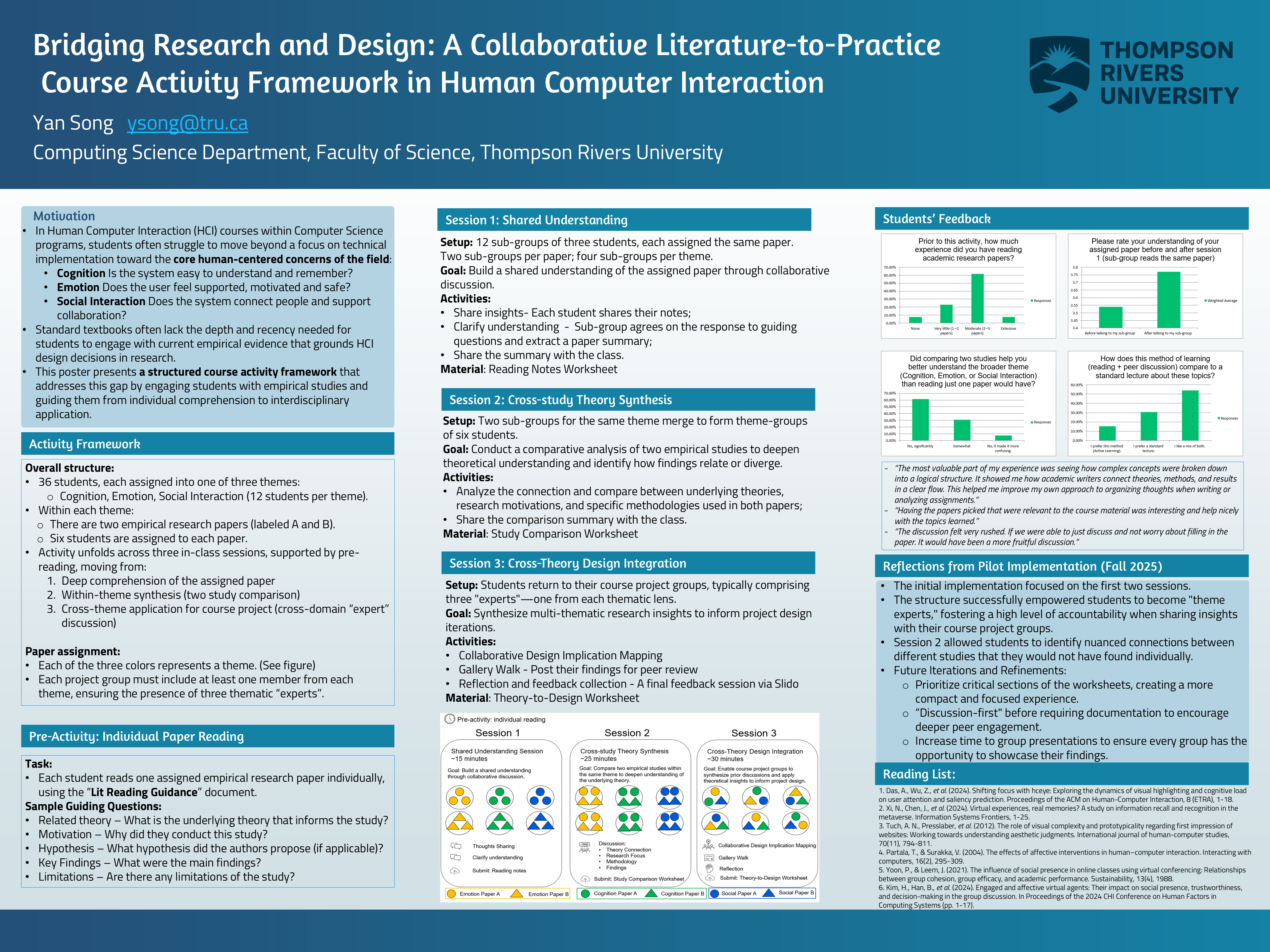
We present a Jigsaw cooperative learning structure where students analyze literature across three thematic streams. The poster visualizes the three-stage design: (1) building shared understanding through deep reading, (2) synthesizing theories across comparative studies, and (3) design integration, where students apply diverse perspectives to project decisions.
While the pilot implementation focused on the first two phases, this presentation outlines the complete scaffolding model, including the specific worksheets developed to guide student analysis. We will discuss preliminary insights based on student feedback, offering attendees a scalable framework for integrating academic literature reading into project-based technical courses.
This proposal embodies “Putting People First” by challenging Computer Science students to prioritize human experiences—Cognition, Emotion, and Social Interaction—over technical implementation. Pedagogically, the Jigsaw structure fosters belonging by ensuring every student becomes a “subject expert” whose unique contribution is vital to their group’s success. This interdependence creates an inclusive environment where diverse theoretical perspectives are valued, directly modeling the human-centered empathy required in responsible technology design.